Yet, the bits and pieces may feel somewhat random. (Rest assured they are not.) Discovering the arc of your story demands reflection. This exercise requires time to obsess over the threads — and to then weave them together. To reflect on the fabric that has been created.
You’ll need to be open to feel a bit uncomfortable. To see observe the warp. To digest what you see.
Are there narratives cast about you that do not reflect who you intend to be?
We should never let a narrative persist that is not our own.
Ready to explore the building blocks of your story? Start here with the “I am from” exercise from Mary Phifer’s Writing to Change the World.
Exploring your unique story is worthwhile.
This can be reveal hidden sources of support and the gaps that must be filled.
Because finding meaning — and then being able to move forward — is everything.
Read more about it and try the “I am from” exercise:
Dr. Marla Gottschalk is an Industrial/Organizational Psychologist. She is a charter member of the LinkedIn Influencer Program. Her thoughts on work life have appeared in various outlets including Talent Zoo, Forbes, Quartz and The Huffington Post.
Change is a muscle that we forget how to flex. As a result, it weakens. At some point, we pass an invisible marker and have little tolerance for any kind of change. We lose that child-like sense of curiosity. We stop exploring.
We say that habits are good (and they are), so build a habit of change. As with any other muscle start slowly, then build your capabilities. Begin somewhere. Anywhere. Avoid becoming wedged between your habits — and the inability to envision something new.
Today, I changed my Sirius radio presets. (Which have never been changed). I happily discovered a couple of genres of music. I’ve also added a couple of new outlets to my morning reading routine. (There is nothing like a new writer with a fresh perspective.) To be quite honest, I didn’t know what I was missing.
Even small changes can feel like a burst of energy.
I challenge you to change one element in your routine today. Challenge your team to do the same. Embracing change is a foundational skill that breeds resilience.
See what comes up.
Change is a muscle.
Flex it.
Read more about it here:
Dr. Marla Gottschalk is an Industrial/Organizational Psychologist. She is a charter member of the LinkedIn Influencer Program. Her thoughts on work life have appeared in various outlets including Talent Zoo, Forbes, Quartz and The Huffington Post.
Serving as a coach offers me an opportunity to experience the excitement of a promotion — or an inspired organizational evolution — more often than those in other roles. However, even when clients approach new and positive challenges, anxiety often emerges as a by-product.
Interestingly, this can be healthy. On some level, these thoughts serve as a rehearsal for future events — and realistic assessments of workplace scenarios are a key component in building resilience. This becomes unhealthy, when a racing mind (at 2:00 am) only offers grief and foggy mornings.
Chances are you are actually working out quite a few vital issues about how you’d like to manage yourself. So — capture and utilize the information in a way that offers you guidance down the line. When mulling over these past experiences and future situations, attempt to elevate your thoughts to another level.
Group your thoughts so that they bring clarity.
Notice patterns that tell you something about your unique philosophy of work. (You can also try imagining how you would behave in extreme situations, to flesh out your philosphy.) This process might offer you guidance as you move forward and serve as a base for future decisions.
To facilitate the process, offer yourself a couple categories to group your thoughts. Ask yourself why the experience or conversation was remarkable. Think of what it represents — and why it is meaningful going forward. Couple this with the challenge that lies ahead. For example, how you will approach a new team or challenge.
Try these categories:
Experiences/observed behaviors/conversations that represent the philosophy of how the work should be completed.
Experiences/observed behaviors/conversations that represent your philosophy of how people and teams should be treated.
See where this leads you. Add categories as you see fit.
Sleepless night don’t need to be a total waste when foundational work gets done.
Simply offer your racing thoughts a bit of structure.
Dr. Marla Gottschalk is an Industrial/Organizational Psychologist. She is a charter member of the LinkedIn Influencer Program. Her thoughts on work life have appeared in various outlets including Talent Zoo, Forbes, Quartz and The Huffington Post.
In order to evolve — we need believe that we can learn. That we remain a work in progress.
That who we are (and might become) is neither fixed nor predetermined.
This belief is embodied in the work of Dr. Carol Dweck, who explores a construct named a “growth mindset”. Simply put, a growth mindset is the belief that we can evolve — and continue to improve — through hard work and determination. (The opposite of course, is a “fixed mindset”.) A growth mindset helps us to expand our horizons and consider taking the risks needed to move forward.
None of us embodies a pure “growth mindset”, as we all find ourselves in situations where the costs may be intolerable. As Dweck explains:
One reason why is we all have our own fixed-mindset triggers. When we face challenges, receive criticism, or fare poorly compared with others, we can easily fall into insecurity or defensiveness, a response that inhibits growth.
All in all, we must commit to the value of learning.
A realization that our minds are not stagnant, but are ready to blossom (again).
So, leave the lights on.
Our potential is unknown.
Tomorrow is another day.
Cheers to that.
Dr. Marla Gottschalk is an Industrial/Organizational Psychologist. She is a charter member of the LinkedIn Influencer Program. Her thoughts on work life have appeared in various outlets including Talent Zoo, Forbes, Quartz and The Huffington Post.
Most organizations would like to innovate or disrupt. However, it is the culture that needs to be re-aligned, not the employees.
If you unleash competent individuals on a new task, you must offer more than a timeline to foster creativity. Few people will take a risk (and waste your time and theirs) if they aren’t first offered the freedom to explore that proverbial limb.
Instead, they will likely transfer what has worked successfully for other tasks to your project. If real change is desired — offer a reprieve from the fear of risk and/or possible failure. Be upfront. Communicate that the risks have been acknowledged.
Lend them the freedom to create.
If you truly want to see something new, take of the handcuffs and offer permission to explore.
Dr. Marla Gottschalk is an Industrial/Organizational Psychologist. She is a charter member of the LinkedIn Influencer Program. Her thoughts on work life have appeared in various outlets including Talent Zoo, Forbes, Quartz and The Huffington Post.
When a construct becomes culturally significant — words naturally arise to describe it. In a sense, the language of that culture expands to accommodate its importance.
The term “employee engagement”, for example has gained a certain level of notoriety — helping us move beyond the 9 to 5 definition of our jobs. With that recognition, we acknowledge that work isn’t just work for many of us. We are realizing that the core of our work should align with who we are — or how we would like to contribute. So, why has it taken us so long to find the right words to describe this dynamic?
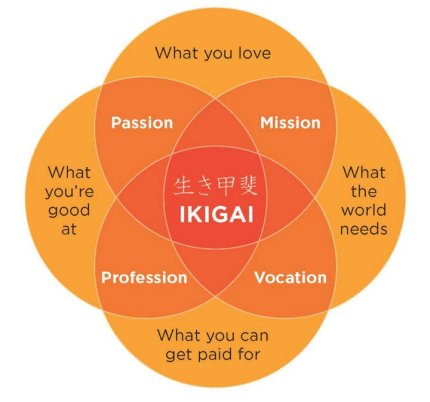
Within other cultures the vernacular has already developed to properly represent the importance of meaningful work within our lives. In Japan, for example, the storied concept of Ikigai, represents our “reason for being”. (See the Venn diagram below, with intersecting circles representing what you love to do, your strengths, what the world needs and what you can be paid for.) In Scandinavian cultures, the word was “Arbejdsglæde” captures this. Translated into English this means “happiness at work” or “work joy”.
These are more than compound words which sling together “work” and “happiness”. These words capture the notion that to feel worthy — we all need to contribute in a way that we feel is meaningful. That immediately elevates how we view our work.
I’d say we need at 100 words to express that.
Read more about it:
Dr. Marla Gottschalk is an Industrial/Organizational Psychologist. She is a charter member of the LinkedIn Influencer Program. Her thoughts on work life have appeared in various outlets including Talent Zoo, Forbes, Quartz and The Huffington Post.
We all possess some form of a personal brand, whether or not it is actively constructed. If you desire to be noticed for the right reasons — that brand must be clear and concise. If it is muddled, you might be lost in the shuffle.
That brand can also be stretched beyond recognition. You may not even recognize it.
(It’s a noisy world out there.)
When people consider you (or your work) it conjures up a certain “gestalt”. While you may think your brand is clearly written in your resume or LinkedIn profile, much is invisible. It is what you do, share and say everyday.
However, it is vital to be noticed and understood. It is devastating to be misunderstood. (I’ve personally experienced this.) What you stand for as a friend. As a colleague. The type of work you envision. The roles you are aiming for. What you wish to accomplish. As, Tom Peters declared in his now classic article — we each must accept the indisputable existence of the personal brand.
It follows that building this brand requires thought — and action — and more thought.
That must begin with you.
You are person 0.
If you could conjure the ideal personal brand that represents you in the future — what would others say? How might that compare to what others would say in this moment?
You have an opportunity to impact that brand. To choose its components and even utilize it as a compass for your career. To delineate the value you bring and to decide the channels that broadcast value. However, you must first build self-awareness.
You must ask the question again (and keep on asking).
Who are you?
Dr. Marla Gottschalk is an Industrial/Organizational Psychologist. She is a charter member of the LinkedIn Influencer Program. Her thoughts on work life have appeared in various outlets including Talent Zoo, Forbes, Quartz and The Huffington Post.
As a rule, it seems to be either maligned or glorified — with no accepted rules of engagement. There are no shades of gray, where we can blend what we need to do, with where we want to go. Ambition is granted a very narrow lane, only accepted for the likes of founders or CEOs. For the rest of us, the message is murky.
Is ambition good or bad? Should it be supported?
Well, this all has to stop.
Ambition should be embraced in many more situations — and in many more of us. (It can be the spark for so many great things to occur.) When we ignore ambition, we can feel frustrated and disconnected. We’ve all suffered through periods of time in our work lives that we could label as a “crisis of contribution”. A point where we felt unmotivated and disengaged.
I’m convinced it was our ambition grumbling to do more. Waiting for its chance in the sun. The chance to do great things.
Ambition should acknowledged, reckoned with and supported.
It is not always synonymous with greed.
And I am convinced it isn’t always blind.
Want to read more about ambition? I enjoyed this book:
Dr. Marla Gottschalk is an Industrial/Organizational Psychologist. She is a charter member of the LinkedIn Influencer Program. Her thoughts on work life have appeared in various outlets including Harvard Business Review, Talent Zoo, Quartz and The Huffington Post.
It is clear that we are missing something vital — an unsung element that could possibly help more women reach their potential.
One such element that may be vastly underutilized is mentoring.
Without mentors, meeting our potential can elude us. We might fail to build the mastery and confidence we need, or envision our own potential. While there is ample research to back up the merits of mentoring, we need to pause and reflect on the topic.
Why are so many women seeking mentors — yet cannot find them?
It is time to pause and openly discuss this question.
One great example of elevating the mentorship conversation is Johnson & Johnson.
At Johnson & Johnson, they have a steadfast commitment to the role of mentoring in women’s careers — as they are committed to igniting the power of women to create a healthier tomorrow. More mentors are stepping forward. Two ideas are central to this initiative. Firstly, mentoring is a valid tool to increase the number of women in management (at Johnson & Johnson this is 43% in the U.S.). Secondly, reaching out to young women in their formative years is critical. Through Johnson & Johnson’s mentorship partnership with Girls Inc., women executives are being paired with high school students who would like to make an impact within their own communities.
Why are mentors so scarce? While we often offer support to initiatives that seem worthy, our directed energy may not fully match our commitment. Not because we do not believe in what we are supporting, but because we are unsure how to move forward.
Why are mentors so scarce? While we often offer support to initiatives that seem worthy, our directed energy may not fully match our commitment. Not because we do not believe in what we are supporting, but because we are unsure how to move forward.
Becoming a mentor can feel like a daunting task. However, it doesn’t need to be. We can all do more.
The bottom line is this: We hesitate to step forward and mentor women. Yet, mentoring relationships can alter someone’s life and career — serving as a loud, positive internal voice in an often noisy environment.
Strong, empowered women are raised by many.
Addressing the reasons behind our hesitation is vital. Research has pointed to the reluctance concerning time commitments and concerns about appropriate expertise. We need to collectively move past these thresholds. Move beyond our fear of a misstep, when we can do so much that is right.
Let’s pose a collective challenge.
Mentor another woman — a young girl, a student. A less established co-worker. Another woman’s daughter. Your niece. Your neighbor.
Someone who might truly benefit from your knowledge and experience.
A few things to consider:
You may not see yourself as a mentor — but you do have that capability. Every time a contributor reaches out to you, it is a signal. A signal that you may be viewed as a mentor. Explore the following questions: How can I help or support this individual today? Is there something I have learned in my journey that may help another woman evolve positively? To help them grow?
Mentoring is about small steps. We tend to think of mentoring as an overwhelming, grand commitment. However, it takes a community of people to build a strong career. Small moments can matter. They sum to a notably stronger foundation on which to build a career.
Be honest about your own journey. Although it may not feel entirely comfortable, reflect on the moments where you needed guidance and received it (or did not). Use these moments as a guide to help others.
Consider sponsorship as well. If you remain hesitant to make the mentorship commitment, consider sponsorship as an alternative. Shine the spotlight on another’s work. Make an introduction. Encourage productive collaboration. Help build stronger networks of expertise.
We do not need justification to nurture another’s talent or recognize a job well done.
Mentoring is about seeing ourselves in a supportive role.
It is about being generous.
Sharing what you know.
Supporting the same inflection points, where you may have needed a boost.
It is about building someone up.
Helping someone see their own potential.
Mentoring is the right dynamic.
You are perfect for the role.
Dr. Marla Gottschalk is an Industrial/Organizational Psychologist. She is a charter member of the LinkedIn Influencer Program. Her thoughts on work life have appeared in various outlets including Talent Zoo, Forbes, Quartz and The Huffington Post.
According to just about everyone — you are supposed to “discover your in-group”.
Oh, that coveted entity! That sacred clan who will naturally “get you” and vibe with your very “essence.” They will “protect” you and explore life’s adventures with you and feed you with their own fingers and — I’ll stop.
My mockery betrays me. (In fact, it even smells a little like resentment.) However, the truth is this: I’ve discovered that I’m a bit of a “wolf pack of one”.
I haven’t found this group yet. I have also discovered, that I don’t want to find one.
Let’s explore the contradictory messages we are offered about this dynamic: 1) Being deeply connected to a like-minded group is the Holy Grail of belonging & 2) only inside that safety, are we then praised for being courageous, independent and self reliant.
Huh?
If however, you are someone who actually prefers to walk alone (as I am) and find yourself outside of a group (yet, self reliant) — you might be viewed skeptically. In fact, you may be told that you just haven’t found it yet. (It may also be decided that you haven’t experienced the real joy of life.) Worse yet, potentially viewed as an unapproachable loaner.
What?
My own intense reaction to the idea of seeking all of this, is actually a little laughable. For years I’ve tricked myself into thinking I was experiencing profound feelings of loss and loneliness because of my status. I’ve always felt like an outlier, alone in a crowded room. But, I have also discovered that group after group, didn’t fit my vibe. The notion of becoming “an in-group member” actually made me feel strangled, forced and confined. I found myself trying to back away.
Not sure if you prefer to be group-less? Here are a few things I joyfully observed about myself, as the “lone wolf”.
Perhaps you will relate:
Groups fail to energize you. You might hang out with a group, feeling like you have nothing to contribute to the conversation. To be quite honest, it just doesn’t interest you all that much.
The topics don’t fit. In many groups, you find that the things you want to talk about — are things that pretty much no one else wants to talk about. (Frankly, you are a little relieved, because they may not do your awesome topic justice.)
You avoid the hootenanny. You don’t want to go to Wanderlust with a bus full of people — or discover sand in crevices where it should never be at the Burning Man festival. (I won’t even mention another Young Living Oil party, drinking wine on a Wednesday night.)
“Give me space” is your mantra. You might actually love Young Living Oils, but you would rather shop online from the privacy of your own home.
Just no. Shopping with another person makes you itch.
You are a not a “regular”. You walk into a yoga class and everyone stops talking and turns to stare. “Who is that?!” someone asks and everyone shrugs.
Your need for contact is “camel-like”. You intensely enjoy a few really great people and every time you see them you think “I love being with him/her” — even if you don’t see them again for months.
You simply don’t drink the Kool Aid. When people start a conversation and it starts to remotely resemble “group think” you want to bolt.
You are content with doing your own thing. You genuinely do not feel a bit jealous when you see group photos of everyone’s fabulous groups having great fun posted (just about everywhere).
You totally, genuinely, love being alone.
For all the group-centered folks reading this, please know that the notion is great if that is what you are seeking. But, not everyone requires one.
If you are like me, try not to automatically feel that you are less of a full spirit — or missing out of something “deeply sacred”.
Finding this group may be important to many people.
However, that doesn’t mean you are one of them.
Keep doing what makes you feel energized and whole.
Be that wolf pack of one.
As for myself, truth be told — my pack consists of my son, my daughter and my husband.
Because you know what?
They totally “get” me.
Allison McClintick is a seasoned coach & speaker — specializing in influence and consciousness development. She’s a Mom of 2 (20 years & 6 years), a ridiculously talented house painter, lover of quantum physics and is currently pursuing a PhD in Psychology. To balance all that life, work and play — she’s attempting to “think” more effectively with practiced meditation. She’ll keep us updated.
Live.Work.Think.Play shares observations concerning a wide array of topics from running a company — to choosing the right gift. It is designed to share lessons learned from a variety of perspectives.















 The Tilbury Edit