
Uncategorized

The Everyday Guide: Our 3 Favorite Desk Styles for Working From Home

Photo by cottonbro studio on Pexels.com

Note: Click on photos for more info.

It is no longer as difficult, to justify a work from home purchase. Many of us are logging in hours away from an office environment. Yet, if you are still struggling to be productive because the dining room table you’ve commandeered just isn’t working or really have no surface to really call your own — we’ve gathered desk options to help you along (yes, you may find a drawer or two helpful).

When I posed this to the group, we were in complete agreement that where desks are concerned — form must follow function. Yet, while we couldn’t agree on one style, any option needed to be easy on the eyes & fit within a decided space and budget.

So, here are a few classic design picks, that weigh in at different styles & price points. Hopefully one of these might inspire you to break your “desk commitment” phobia.

Unless indicated — simply click on the photos for more information.

Sophisticated
I’ll admit that I am not a particularly elegant individual. I struggle with lipstick and despise clothing that doesn’t feel like pajamas. However, a glamorous desk can make you feel a bit cool & somewhat collected. The lacquered regency desk below from Anthropologie is pricey, but offers four drawers (spaces to wrangle your stuff.) Find the details here. Fans on a budget can consider our Amazon pick.

Lacquered Regency Desk from Anthropologie.

Modern
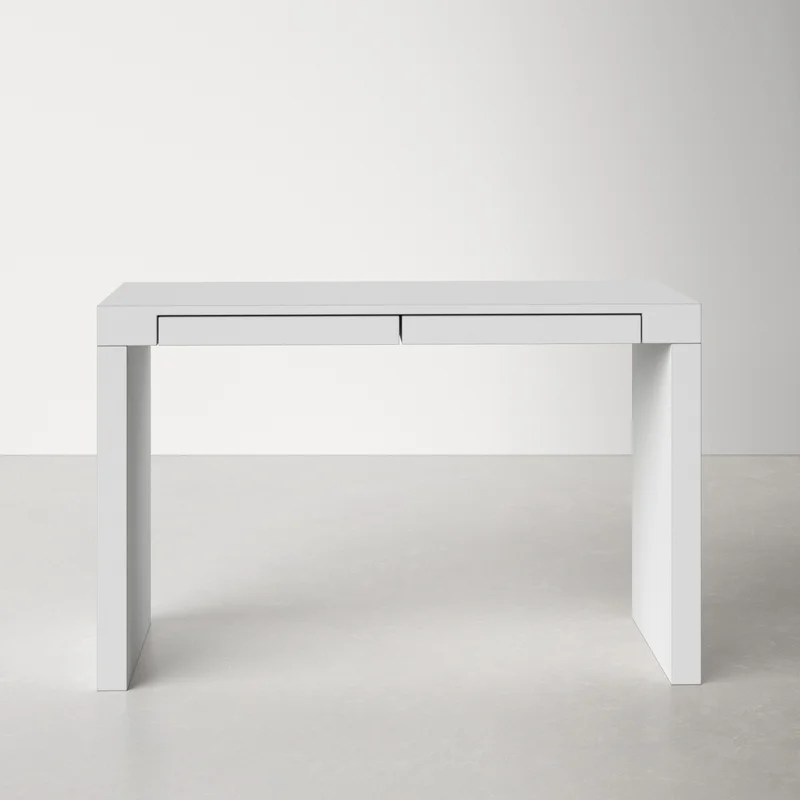
There is something something so refreshing about clean, modern design. The lines are sleek and the materials quickly become the center of attention. Luckily, there many options out there to choose from. I love the look of a Parson’s style desk and the one below from All Modern is well-rated. We’ve also included other desks with a modern feel at a lower price point.

All Modern’s Carson desk: Find it here.

Cyrene+Reversible+Desk

Hogwarts (Library Table)
If spreading out is a priority and you have storage for your office supplies covered, there is nothing like a library table. You can go for a new option, pre-owned or even a vintage table — representing various price points. Find some tips on how to purchase a vintage piece here.

Trestle tables are great options and work beautifully if an unused dining room space has morphed into your home office. Hogwarts aside — you just cannot beat the warmth of this style option. We’ve provided a little inspiration below: here is the direct link: https://amzn.to/48yR4rK

What is your favorite desk style and why? Share it below.

The Tilbury Edit shares observations concerning a wide array of topics from founding a company — to the perfect office gift. It is designed to share lessons learned, from a variety of perspectives.

Uncategorized

You Should Be Your Own Muse


hai-tran-tt_hfmmae1w-unsplash

Muse
1: any of the nine sister goddesses in Greek mythology presiding over song and poetry and the arts and sciences Clio is the Greek Muse of history.
2 : a source of inspiration especially : a guiding genius The writer’s beloved wife was his muse.
3 : poet

My grandmother used to stock a drawer on the end of her bright, pink kitchen with crisp, white paper. When I visited her as a young child it always felt that it was waiting for me. Whether she placed that paper to indulge my early penchant for sketching, I’ll never know. But, I’m grateful that she provided the materials which acknowledged and in a sense, normalized creativity.

Being able to create something, whether great or small — helps us build a stronger core; one that extends to both life & work.

Yet, as we all know, inspiration can be difficult to come by, even in the best of circumstances.

On some level, it may seem frivolous to indulge the notion of an “inspirational state” (more about that here). But, I have come to think it wildly essential to our lives. Something that underscores the best of being human. Of finding & expressing our own individuality.

Yet, I also know, that if we continually rely on other people to help the creative process ignite, this puts us at a distinct disadvantage.

While you are likely grateful for what you do have in this moment, your life & work may suffer from a lack of inspiration. The usual “triggers” may be absent or limited (life has changed over the last few years). But, I’m a stubborn sort and feel that there are ways to build the potential for creativity within our daily lives. I’ve relied on this vantage point for some time now. On some days I am successful. On others days, not as much. But, I am resolute and committed to the process.

To combat this internal gridlock, we must find what we might need from within ourselves. More specifically, to find our own energy sources. My own journey has led to a number of observations — including this:

We must learn to function as our own muse.

Here are a few of my tips & techniques:

Pay attention. You must become more sensitive to your own distant drummer & indulge the pangs of interest. What are you drawn toward? A development in an adjacent field? A new writer? Design thinking? Attempt to not dismiss a seemingly random element that attracts you, however unrelated it may appear to your life or work. Read more on that topic. Talk more about it. Ultimately, if your brain engages with something — the benefits are likely to spill into other areas.

Get a hold of morning rituals. What are you consuming along with your coffee, first thing in the morning? What fills the first moments each day? How might this affect you? How can you better control negativity, tension & stress (which likely fight inspiration and creativity)? Know this: cultivating inspiration & creativity is an art form — and not the result of divine intervention. We need to address the roadblocks that we might create for ourselves.

Stop the energy drain. There are people & situations that truly drain us — drowning our abilities to serve as our own muse. If someone or something consistently leaves you in a funk, stop the exposure or contain the effects as soon as possible. Process why the interactions affect you in that way. Resolve to change your perspective and attempt to move beyond it.

Edit your physical surroundings. Our immediate surroundings have become more and more important. Pay attention to where you work & where you relax. Pull out items or mementos that help you feel safe & settled. Organize your office in a way that feel more intentional. Insert a healthy dose of art or music. Do what you can to trigger positivity.

Utilize a dreamy state. Writer’s block, a well-known ailment, known to be quite difficult to tackle — has been discussed for centuries. This article offers a glimpse regarding how mental imagery can open the door to recovery. In a sense, writer’s block is simply a creativity deficit. A frozen state, in which the sufferer is caught without a worthy muse.

Indulge, not stifle. Try not to shrug off an idea or collection of observations. Grab a notebook and record the source idea. Then use that page as a nexus for related branches & refinements. Return regularly and build. Be loose with your thoughts. Try not to edit your creative meanderings too heavily.

Get visual. Creativity breeds creativity. So being a bit closer to the visual arts, may help you feel more productive. I challenge you to discover 5 inspiring photographs or photographers at Unsplash. Note the subject matter and why you are drawn to it.

Go ahead and create something, anything. Whether you have raw talent or not — dabble. Choose a vehicle that attracts you, whether it involves paint, pencil, ink, a hammer or a camera. Remember that creative acts, can be pursued solely for your consumption and no one else’s.

Please note that you do not have to work in a known “creative field” to benefit from the contributions of inspiration & creativity into your life. I would wager that both of these elements, fund both our well-being and problem-solving abilities.

Inspiration requires that we become acutely aware of our own creative triggers.

Let’s find them.

Then go ahead and pull that thread.

Know someone who might benefit from this read? Share the post with them.

Read more: Thoughts on Asimov’s The Eureka Phenomenon here.

Marla Gottschalk is an Industrial/Organizational Psychologist and charter member of the LinkedIn Influencer Program. Her thoughts on work life & have appeared at Harvard Business Review, Forbes, BBC Work Life, Quartz and The Huffington Post.

Live.Work.Think.Play shares observations concerning a wide array of topics from founding a company — to the perfect gift. It is designed to share lessons learned from a variety of perspectives.


Uncategorized

How Work (and Other Things) Might Help Us Cope Right Now.

cathal-mac-an-bheatha-cvRKmOp_fl4-unsplash

It is 2020.

We are all struggling to establish a new normal, in times that are anything but normal. I’ll spare you and will refrain from sharing advice about how to work remotely. We are in the midst of history being written. That alone demands that we peel away the layers of the onion.

Many of us simply want to protect ourselves, our families and quite possibly our well-being. Know that psychological resources such as hope, self efficacy and resilience, can be adversely affected as we practice social distancing.

As an alternative track, I’ll share few thoughts on how to stay on a somewhat even keel. (Disclaimer: These are my own. They do not have to be yours.) Not surprisingly, this does include work and seeking a daily measure of joy. Know that I am referring to the type of work, that feeds your soul and occupies your mind. I am also referring to the trusted elements of our lives to which we turn, when feeling unsettled.

What to try now:

  • If possible, continue to do the work you love to do. I’ve just listened to Coldplay’s Chris Martin live streaming an impromptu home-based concert at Instagram (@Coldplay). As a psychologist, I’m thankful that he can continue to share his gift to help others. Try to do the same. Work on topics that bring meaning & value to you.
  • Reach out. Limit feelings of isolation & distance. Technology can obviously work with us here. I couldn’t love Zoom more than I do today, in this very moment. I intend to contact the clients & colleagues, I’ve come to respect over the years. Utilize Facebook video to call friends who are alone (quite reliable) and text your neighbors. I’m hoping this helps in some way.
  • “Lean in” to the things that bring joy. Whether this is music, film, reading, art, walking, observing birds, podcasts, comedy, singing, blogging, or crafting. Do these things when you have a moment. James Altucher just shared his reading list as we self-isolate. Shuttered Broadway performers are singing for us. Museums have shared virtual tours. Improvise. Build these into your daily routine.
  • Complete something. Anything. When we cannot control our circumstances, self-efficacy suffers. This can lead to feelings of helplessness. While you distance, complete smaller projects/tasks that you can pace. Bring feelings of mastery into your “new normal”.

We are all struggling. Share your concerns to someone that you trust.

What are you doing right now to support your psychological foundation?

Dr. Marla Gottschalk is an Industrial & Organizational Psychologist. Live.Work.Think.Play shares observations concerning a wide array of topics from founding a company — to the perfect office gift. It is designed to share lessons learned from a variety of perspectives.

Uncategorized

Want To Be More Creative? Here’s a Plan That Really Works

tanialee-gonzalez-698417-unsplash(1)
Photo by tanialee gonzalez on Unsplash

“It is my belief, you see, that thinking is a double phenomenon like breathing.” – Asimov

If you have watched the classic television series House, you’ll find that every medical mystery is solved in the most unusual of moments. Without fail, House’s uncanny ability to problem solve kicks in while he sits in the hospital cafeteria, is mid-sentence while talking to a team member or when he doesn’t outwardly appear to be focusing on the problem on deck.

It is very intriguing to watch.

But, we shouldn’t be surprised as to why this happens.

You see, our brains function in curious ways.

Your Brain Revealed
In the classic essay The Eureka Phenomena  (1971), Issac Asimov explores why these moments of inspiration occur when we least expect them. Asimov’s theory is quite simple, posing the notion that thought includes both voluntary and involuntary components. Moreover, opportunities for both types of thought must be present to become highly effective. Essentially, we can be thinking about one thing on the surface, yet ruminating on another topic below — the involuntary part of the equation.

The Eureka Phenomena sheds an interesting light on how we might become more effective in the workplace. As we all have experienced, if you are focusing too long and too intently on one topic or issue, you can be unsuccessful. Asimov would say that involuntary thought was not allowed to flourish and that contributed to the failure.

He recollects that when he was in the midst of a problem he could not solve, he shifted his focus and “shuffled” off to the movies. This action ultimately, allowed him to work through his challenge. He also tells the story of Archimedes — and how a visit to the public baths helped him to discover the concept of volume.

Of course, you may find that taking a walk or baking does the trick, but the process is of no less importance. You must give your brain the “down time” it needs to succeed.

Office Life and Involuntary Thought
There are millions of individuals who have the responsibility to process information concerning people, places and things for a living. Many attempt to accomplish this in an office environment. Of course, working in a traditional office does have merit. There are opportunities for collaboration and serendipity — yet obstacles to productivity abound. As discussed by Jason Fried in his classic Ted Talk, many aspects of office life (such as interruptions), can prove to be huge offenders, curtailing deep, meaningful thought.

During the course of a typical office work day, an individual may complete a multitude of activities and appear outwardly productive. However their brain power may not be maximized, as there are few opportunities to rest, reflect and digest information.

The Eureka Phenomena Applied
You must remember that while thought doesn’t require physical output, your brain is still hard at work. So, while you may not perceive that you are fatigued, your brain may actually be exhausted. As studies have shown, allowing the brain time to rest is critical. In this way, the brain finds the fuel it needs, so that energy can be funneled to the involuntary mechanisms that promote deeper thought. If we can learn anything from Asimov — it is that the brain cannot be bullied into becoming effective. It must be respected and nurtured.

Be mindful to offer your mind a bit of rest and identify those activities which help your brain relax and build them into your day.

Ultimately — don’t feel guilty if you feel the need to “shuffle off” to the movies. Your brain will thank you.

Live.Work.Think.Play shares observations concerning a wide array of topics. It is designed to share lessons learned from a variety of perspectives.

Uncategorized

Considering Words, Work & Happiness


jacqueline-munguia-1pAwJiCD60c-unsplash
Photo by Jacqueline Munguía on Unsplash

When a construct becomes culturally significant — words naturally arise to describe it. In a sense, the language of that culture expands to accommodate its importance.

The term “employee engagement”, for example has gained a certain level of notoriety — helping us move beyond the 9 to 5 definition of our jobs. With that recognition, we acknowledge that work isn’t just work for many of us. We are realizing that the core of our work should align with who we are — or how we would like to contribute. So, why has it taken us so long to find the right words to describe this dynamic?

Within other cultures the vernacular has already developed to properly represent the importance of meaningful work within our lives. In Japan, for example, the storied concept of Ikigai, represents our “reason for being”. (See the Venn diagram below, with intersecting circles representing what you love to do, your strengths, what the world needs and what you can be paid for.) In Scandinavian cultures, the word was “Arbejdsglæde” captures this. Translated into English this means “happiness at work” or “work joy”.

Igaki

These are more than compound words which sling together “work” and “happiness”. These words capture the notion that to feel worthy — we all need to contribute in a way that we feel is meaningful. That immediately elevates how we view our work.

I’d say we need at 100 words to express that.

Read more about it:

Dr. Marla Gottschalk is an Industrial/Organizational Psychologist. She is a charter member of the LinkedIn Influencer Program. Her thoughts on work life have appeared in various outlets including Talent Zoo, Forbes, Quartz and The Huffington Post.

Uncategorized

Job Interview Jitters: Try A Dose of Mindfullness

jeremy-bishop-556948-unsplash

When we lose ourselves in a stressful moment — a workplace situation can quickly escalate from challenging to completely overwhelming.

For many of us, job interviews are a common scenario that can trigger strong responses; anticipation, excitement, trepidation, even extreme anxiety. If you’ve sat in the interview chair, you are likely aware of the struggles we all face to remain calm and focused. As much as we might attempt to stay composed our minds can race out of control, just like a runaway train. Managing ourselves through this stressful dynamic is key.

Could the concept of mindfulness possibly help all of us through the challenge of an interview? Recent research tells us that it can.

Tough workplace scenarios can cause our “fight of flight” response to kick in — and job interviews qualify. Labeled “Amygdala Hijacks”, by psychologist Daniel Goleman, these moments are characterized by a neurological process where our “rational brain” (Neo-cortex) becomes overpowered by our emotional brain. This renders us in a weakened position to deal with many situations effectively.

Mindfulness is defined as, “The psychological state where you focus on the events of the present moment.” It allows us to observe the events of our lives from a safer distance, without necessarily reacting in that moment. One key element, is the notion of equanimity, or “non-reactivity” to the events happening around us. Mindfulness tells us to pay attention and acknowledge both one’s inner experience and the outer world, without labeling what is occurring as good or bad. It allows us to absorb what is going on around us.

Discussed at length, concerning its impact on both our psychological and physical well-being (See here), mindfulness can help us remain balanced in many situations that might normally derail us. One recent study links mindfulness to effective workplace behavior. The research revealed that mindfulness may help with roles that require a series of decisions in quick succession — not unlike the multiple decisions/responses we face during a job interview. Managing our automatic responses, and re-focusing that energy toward staying composed is key.

How might mindfulness help us during an interview? Above all, you want to represent yourself accurately. Regrets concerning what you may have forgotten to mention, (or did mention and didn’t mean to reveal) can prove critical. During interviews we can become overwhelmed and “lose our heads”, losing focus on the goals of the conversation. (You might also find yourself either rushing ahead or reviewing your last answer, for example.) Above all, if you fail to remain fully present, you may miss important conversational cues that will help you to represent yourself well.

We needn’t wait for our next interview to develop techniques to become more mindful. Here are a few things to consider:

  • Practice the art of “micro-meditation. These are short periods of time to stop (perhaps when you feel yourself becoming anxious) and become fully present in the “here and now”. For example, while waiting for the interview to begin (seems these things are always delayed), utilize the following acronym taught at Google: S.B.N.R.R. — Stop. Breathe. Notice. Reflect. Respond.
  • Tame the “inner voice”. Don’t let an inner monologue take over during the interview. (For many of us this is negative.) Be aware of a “less than supportive” inner dialogue that might rear its ugly head. Consciously interrupt it and replace it with a less judgmental voice.
  • Refocus on your ultimate goal. Remind yourself of the purpose of the interview: to accurately portray yourself as a contributor. We all have topic “triggers” that cause us to lose focus and react. Monitor your reaction to these topics, and remind yourself to stay ahead of your usual response pattern.
  • Stay in the moment. While we can’t halt the interview for a quick meditation break — we can silently “tap ourselves on the shoulder” to remind ourselves to remain fully present. When you feel your mind racing ahead or meandering back to something already said, mentally pause and “tap”. (As suggested here, plant a reminder to help you re-calibrate, such as wearing your watch upside down.)
  • Bring along a mental list. Enter the interview with 3 or 4 critical points that you wish to leave with the interviewer. Use mindfulness techniques to pause, circle back and ensure that these key points are brought into the conversation.

How do you stay calm and focused during an interview? Share your strategies.

Dr. Marla Gottschalk is an Industrial/Organizational Psychologist. She is a charter member of the LinkedIn Influencer Program. Her thoughts on work life have appeared in various outlets including Talent Zoo, Forbes, Quartz and The Huffington Post.

Uncategorized

To Move Forward — Be Constructively Critical (of Yourself)

paulina-milde-jachowska-cbuzy3s2ES4-unsplash

Photo: Paulina Milde Jachowska @ unsplash

We all would like to think that we do things well — and a strong belief that we have the skills to succeed helps us in most workplace situations. However, there can be unwanted “glare” concerning those same skills that can create a gap in self-knowledge.

In fact, our own confidence can impede us from looking at our own behavior with a constructively critical eye.

Succumbing to bias concerning our own workplace strengths isn’t an easy dead end to face. Moreover, the areas that we most value in ourselves (and likely derive the most satisfaction) — can be the most heavily protected. As a result, we are less likely to look for opportunities to examine our own skills critically. In fact, research has shown that we tend to view our own skills more positively than our peers see us.

So it is possible to be unaware of a problem on the horizon.

Organizations that have enjoyed success — can blindly stop looking toward the future. People that have proven expertise, can also stop looking for avenues to grow. It is a weakness that we may not see, that can become a future impediment. It is important to realize that meeting our current goals, does not ensure our continued competence.

Only a keen eye and professional development, can help us stay in the right groove.

So I’ll pose these questions:

  1. What skills do you personally value most at work?
  2. Have you paused to critically examine your performance within these areas recently?
  3. Can you identify an element that could improve?
  4. Has there been a shift in the external environment that affects your skill set?
  5. How would/could you improve? What actions would you take?

I challenge you to look at your own skills critically and find a strategy to stay “skill healthy” longer-term.

What did you identify?

Dr. Marla Gottschalk is an Industrial/Organizational Psychologist and worklife strategist. She is a charter member of the LinkedIn Influencer Program. Her thoughts on work life have appeared in various outlets including the Harvard Business Review, Talent Zoo, Forbes, Quartz and The Huffington Post.

Uncategorized

Why It’s So Hard to Leave a Job (Even the Ones We Secretly Hate)

laptop on a wooden white desk
Photo by Karolina Grabowska on Pexels.com

Most of us have experienced moments where we struggle to move forward. We may have detected that something vital has shifted — yet we hang on to a role (or a freelance gig or a team membership) that doesn’t really suit us. In many cases, the signals to explore alternatives are completely missed, often overwritten by our dismissive inner monologue.

So we remain. Long after it is time to say goodbye.

After years of hearing stories of roles that do not fit (not to mention, bosses & organizations), I now hold a strong view that the need for change is actually an inevitable occurrence. It is not unlike the coming of the sunrise or sunset; and we should count on it. If we could somehow manage to accept these inevitable impasses as positive — not unlike changes in technology — we hopefully could avoid the shock and somehow move on.

Ultimately, when we find the psychological resources  to move on to seek a better fit — it is often for the best. These are transitions, not sentences after all. If we can accept changes in styles, markets and devices — why can’t we embrace the evolution of ourselves and our own paths?

There are beliefs that convince us to acquiesce control over our work lives and leave things to fate. I’d like to challenge a few of those beliefs:

  1. We are conditioned to “hang on” and forgo risk. Yes, a miraculous “in place” improvement is possible (a bad boss might move on for example). However, forgoing all risk in the short-term can be a hand ill-played. We might fail to acknowledge that the psychological contract (which serves as the baseline for a healthy employee-employer relationship) has already been irrevocably broken. When we remain, we risk being physically present at work — yet mentally absent.
  2. We secretly hope that everything (including ourselves) will remain static. Of course, this belief predisposes us to be unhappily surprised at each and every turn — as change is going to happen. To complicate things further, we are notoriously inaccurate about how we personally evolve over time. (How often do we stop to envision our “future self”?)  Truth: The roles that fulfill us now, may not be the same roles that might excite us five years on. As Daniel Gilbert has shared: Your history does not end today. (Learn more about the “End of History Illusion” in the video below.)
  3. Seeking a role which is more aligned with our needs and strengths is frivolous.  Oh wow. Do not get me started. On some level, many of us think this quest is a “pie in the sky” mantra. So we avoid the entire conversation — and with that neglect, any hope of an improved option. For example, early in our career paths we might feel that we are glued to a role that directly links to our college major. When our needs shift with time, we feel a pivot is irresponsible. Ultimately, much is left unsaid and undone. As the gap widens between who we are and what we do — everyone loses.

We should be ready and willing to embrace how we change.

Moreover, organizations should encourage and facilitate its exploration. This can be accomplished through heightened awareness.

If we do not prepare, I fear we will not be ready for what inevitably arrives.

Our next chapter.

When was the last time you reflected on how you have evolved? Share your observations here.

Dr. Marla Gottschalk writes about life and career as a Top Voice at LinkedIn. Her posts have also appeared at various outlets worldwide including US News & World Report, Forbes, Harvard Business Review and The World Economic Forum.

The Tilbury Edit  shares observations concerning a wide array of topics from running a company — to the perfect gift. It is designed to share lessons learned from a variety of perspectives.
Uncategorized

Ready for a Playlist About Time Management? (Pencil it in.)

elisa-michelet-kR3ahGAazxc-unsplash

Many of us feel that there just isn’t enough time in the day.

I first captured my observations about this common source of overwhelm (and the behaviors I observed) in the post The Ugly Truth About Time Management. The post starts with the premise that time issues begin with our own imperfect perspectives concerning time and value.

However, what resonates concerning improving time management varies across individuals. Luckily, there are quite a few TED speakers who have shared their take on the issue. They each offer a unique view of our ever-present tangle with time.

Here are 3 talks to help you to further understand your relationship relationship with time. (See the playlist at our channel here: https://www.youtube.com/channel/UCPobAd0urxAGPaVu4PNWsIQ)

Greg McKweown. Essentialsm. Time and focus are highly interlaced topics. In his talk at Google, McKeown explores how we often hold ourselves back by having too many “good things” in our lives. The result? Even success can actually lead us down a cluttered path — and less, is often better.

Rory Vaden. How to Multiply Your Time. A self-discipline strategist, explains that everything we’ve learned about time management is likely wrong. From the 1950’s on, we have developed a view of time that doesn’t really help us become more effective. The problem? Time management requires us to consider a new, critical construct.

Laura Vanderkam. How to Gain Control of Your Free Time. Somehow when we must make something a priority, we suddenly have the time. Laura Vanderkam unpacks an interesting dynamic, that plays out day after day in our lives.

How do you manage time? Weigh in on the topic in comments.

Live.Work.Think.Play shares observations concerning a wide array of topics from running a company — to the fragrance. It is designed to share lessons learned from a variety of perspectives.

Uncategorized

Startup Life: How Being Employee No. 3 Was Definitely Worth the Risk

AlyssaPatzius.

Jumping from college to a start-up environment is no small feat for any individual. So, when we set out to find out what laid the foundation for Alyssa Patzius’ current path — we quickly realized that we had forgotten one key question; What was it like to be present at the earliest phase of a thriving organization’s existence? (Alyssa joined shortly after after Kelsey Raymond and John Hall started the company in 2011.)

Alyssa is Influence & Co’s VP of Client Success, where she oversees and supports the sales team, while developing big-picture strategies for growth. She has evolved through a number of roles at the organization, beginning with the title of Senior Account Strategist. But as you’ll find here, her family’s unique experience with risk  — was a career game-changer.

I’ve kept editing to the bare minimum in this post so you don’t miss a single note about her story. In this case we’ll start with a follow-up question right at the start.

Follow-up question: What was it like being employee #3?

Being employee #3 gave me an opportunity to be apart of the long-term vision of the company. The company is essentially just as much mine as the co-founders  — because I have really been there with them since the beginning. It gives me a sense of ownership that I wouldn’t have had otherwise.

I still remember every detail of all three of us sitting around a whiteboard trying to map out the future structure of the company. (Side note: We were completely off.) But as a 21 one year old, my input was being heard.

That would have never happened at any corporate job.

I also had to get comfortable very quickly with acting like I had been in certain situations when I never had. I took on the role of our first account strategist, working directly with clients. (Kelsey and John had been doing this in addition to sales and everything else founders deal with.) But there was no playbook and very few processes to rely on. I worked directly with CEOs of companies and I was seen as the expert in content.

That learned confidence is one of the key elements that I lean on as a female leader. It might get you into a corner every once in a while, if you haven’t done your homework. However, for the most part people do believe me and listen when I speak. I feel it all stems from those imperative learning years.

I also had to be mindful of burning out. We were working very long hours. Once we started to really pick up clients, I was working with 30 companies, plus hiring and training new account strategists to start to build our client services team. My job never stopped! (My now-husband, then boyfriend, said one day to me that I wasn’t actually with him. Even as we were watching TV, I was on my ever-present computer. I worked every night every night, and he was getting concerned. It was a real wake-up call that I needed to learn how to establish a balance.)

The following year I stopped working at nights, and become even more effective.  I valued my time — and when I was working during the day, nothing was going to distract me so I might enjoy my time at home. (I had to battle with feeling guilty knowing that my co-workers may be working all night while I wasn’t.) But over time, I began to see that I was much more effective. Two years ago, my Mom admitted that she really didn’t think the company would last. She was awesome though — and never told me she was skeptical. My brother-in-law took a risk to join a young startup, and he said he was comfortable jumping on board because he was so inspired by the success Influence & Co. has had over the years.

I love that not only that I owe so much to Influence & Co. for my professional development, but that my risk inspired other people to do what they love.

  1. What key factors came together that helped you to find your current path?

My career path may seem somewhat risky to an onlooker. However, looking back I feel like I made safe choices along the way.

When determining where I would go to college, I had my hopes set on doing something different from everyone at my public high school in St. Louis. I was determined to head out-of-state, but when push came to shove I wanted to study journalism. To say “no” to the best journalism school in the country, The University of Missouri, would have been detrimental. So I followed the crowd.

My father brought an internship opportunity to my attention during my senior year of college. One of his friends had a daughter who was looking to hire someone to help run an organization that supported local entrepreneurs. I really didn’t want to be the person who needed my father to set me up with an internship, so I didn’t pursue it initially. (I hadn’t needed him for opportunities prior, why should I need him now.0 However, I begrudgingly took the interview and immediately clicked with my new boss and landed to role.

As graduation approached, my grand plan was to land a sexy PR job in the big city. Instead — I took a role to stay with the startup I had been interning with where I went to college.

On one side, I see a path that leads me on a very direct/safe route. I haven’t strayed from journalism or content (or even Missouri). You can also look at the other angle and see someone who took the risk to graduate early, study abroad, take a job at a startup (with no guarantee of success) and a super low paycheck.

I’ve had to reflect on my career expectations for my early in my adulthood and recognize that I couldn’t ever have imagined what would come my way. I may have never left the state, but I took a risk and bet on myself, an idea — and the people around me.

Today, I am a senior leader at one of the fastest growing companies in America.

There is nothing safe about that.

  1. Did you have a mentor? A teacher, boss, relative, etc. — that impacted your career/life direction?

My mother and father have been imperative mentors throughout my life. At a young age, I watched my father leave a very lucrative role, because he didn’t believe in the culture and the way management was expecting him to treat his people. He had just moved our family back to St. Louis. Now he had to set out to start his own sales training business. My mother stayed at home to take care of the family. Despite being out of the workforce for some time — she was the backbone of the business and the family. She explained to us that we were taking a risk financially to start the company and how this might impact us. (We may have needed to move to another house.) Her continued transparency, helped me become comfortable with risk and taught me how to talk about finances. Over time, I came to idolize those who started their own businesses.

Fast forward: We did not have to move across the street. My father eventually sold his business. He is now the global sales manager for his largest customer.

Note: My mother is still the first person I call for management advice.

  1. None of us are perfectly suited for our own path. What aspect of your own personality or work style serves as an obstacle? How do you manage that challenge?

My gut feelings and instinctive decision-making skills, rarely let me down. It is one of my strengths. However, I have had to learn to slow myself down and think through every possible scenario to make the best decision. Snap decisions were necessary when we started Influence & Co., but today we have 75 employees. Communication around the why and how we make those decisions is crucial to buy-in across the company. If I cannot explain the rational thought process to my team — they could lose trust in me.

I have had the support of our co-founder, Kelsey (Meyer) Raymond, as I tackle this aspect of my personality. She has shown me that this was strength in crunch time . However, if we are proactive (and thinking ahead) there was no need to rely on gut or instinct. I learned that I was actually doing a disservice to my team — instead of feeling proud of being that “get shit done” person.

  1. If you had an observation concerning what separates those who love their work, from those who do not — what would that be?

An interview question that I discovered comes to mind.

Question to candidate: Tell me about something you love to do.

Follow up question: Why do you love the idea of working in [X Industry] for me?

You should observe if they speak with the same passion for both answers. f their eyes “light up” in the same way — they really want to work for you.

If people love what they do, they can’t stop talking about it. When my co-workers and I get together outside of work, we have to start the conversation off by saying “We aren’t going to talk about Influence & Co. today.” Thirty minutes later, someone has an idea for the business they want to throw out there.

  1. With success can come complacency. How do you draw energy from your successes and stay grounded. How do you stay sharp for what might come next?

Once you have tasted success — you never want to lose it. We have experienced 5 very successful years at Influence & Co. However, there is a real chance that the next year won’t be the same. If you become complacent, you become obsolete. It is much easier to be the underdog — than the giant.

I have had to become more comfortable facing the things that didn’t go well in my role or on my team. You won’t really absorb what defines that success for you, if you don’t remind yourself what it feels like to fail.

We have recently had a down sales quarter. It has been a hard few months learning how to pull my team out of that down-slump. I have analyzed the data, played scenarios over and over in my head and examined where I might failed my team as their leader. Just in these last weeks, sales are coming in at a fantastic rate once again. (I forgot how sweet it was, to ring the bell in my office that signals a close.)

If I didn’t make myself feel the failure, the sound of that bell wouldn’t feel nearly as great.

  1. In your world, what activities or tasks most energize you? What advice would you give to young women in college concerning finding the right career path?

Coaching my employees is the most energizing aspect of my role. Nothing makes me happier, than helping one of my sales team members think through how to approach a conversation or alleviate one of their leads hesitations in a genuine way.

Over the last two years I have moved into a sales management role. I started my own career in account management — working with clients directly and supporting those who worked with our clients.

I see so many women flocking to marketing and communications that could be fantastic in sales. (We are still trying to debunk the stigma of cold calling and aggressive cultures to attract women to the sales industry.) I really believe that women are the key to changing the image of sales. Plus, I have seen that women have so many of the characteristics that set people up for success in that role. They are self-starters, organized multi-taskers, great listeners, compassionate and good at building relationships.

I challenge young women to consider a career in sales.

I think they would be surprised how rewarding it really is. And who doesn’t like controlling your own paycheck?

  1. Lastly — what is your favorite book and why?

Shoe Dog by Phil Knight is my favorite book I have read this year. (It didn’t hurt that I read it in Costa Rica.) Shoe Dog tells Phil Knight’s story of how he founded Nike. As an athlete and sports buff, the business was the perfect combination of entrepreneurship and fitness. The book reads like a gripping story.

Once finished — I was inspired to get to work!

Thanks Alyssa.

Live.Work.Think.Play shares observations concerning a wide array of topics from running a company — to the perfect gift. It is designed to share lessons learned from a variety of perspectives.